
Listen to this article
For many in the UK and across the West, the word Kurdish only briefly entered public awareness during the fight against ISIS. Images of brave Kurdish men and women defending cities like Kobani circulated widely, and for a moment, the world seemed to recognise their sacrifice.
Then, almost as quickly, the attention faded.
What is often forgotten is that the suffering of the Kurdish people did not begin with ISIS — and it did not end when the headlines moved on. It is the continuation of a century-long story of dispossession, persecution, and repeated international betrayal.
The Kurds are the largest stateless nation in the world. More than 40 million people spread across Turkey, Syria, Iraq, and Iran — divided by borders they did not choose, governed by states that have too often denied their identity, language, and basic rights. For decades, Kurdish villages were destroyed, Kurdish names were banned, and Kurdish culture was treated as a threat rather than a heritage.
Entire generations grew up knowing that simply speaking their mother tongue could result in prison, exile, or worse.
In Syria’s northeast — a region known to Kurds as Rojava — something extraordinary emerged amid the chaos of civil war. While much of the country collapsed into violence, Kurdish communities built a system based on local democracy, women’s leadership, and coexistence between ethnic and religious groups. Kurds, Arabs, Christians, and Yazidis governed together. Women were not symbolic figures — they held real power.
It was fragile. It was imperfect. But it was hope.
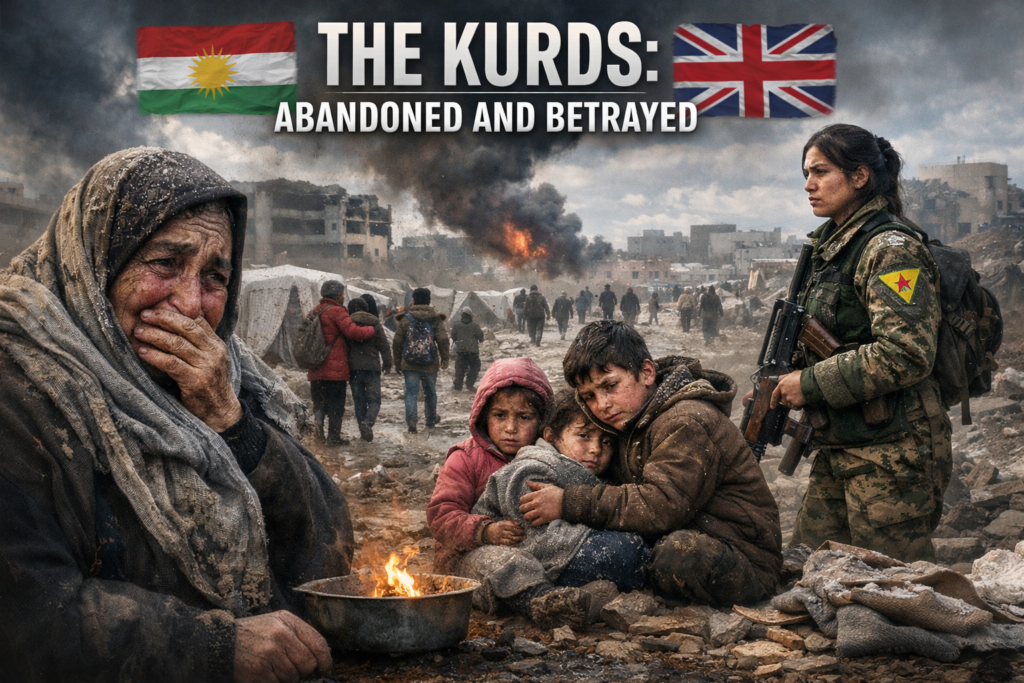
When ISIS advanced, it was Kurdish fighters who stood in their path — often with limited weapons, limited support, and devastating losses. Kurdish women fought on the front lines against one of the most brutal terrorist organisations the modern world has seen. Thousands died defending not only their homes, but global security.
Yet once ISIS was largely defeated, the Kurds were left exposed.
In recent months, Kurdish areas in northern Syria have once again faced military assaults, sieges, and mass displacement. Civilians — not combatants — have paid the highest price. Homes have been destroyed, essential services cut, and families forced to flee in winter conditions. Reports of children dying from cold and shortages of food and fuel are not relics of the past — they are current realities.
This is not simply a regional conflict. It is a moral test.
The international community frequently speaks of human rights, minority protection, and the responsibility to prevent atrocities. But for the Kurds, these principles have too often existed only on paper. Promises of protection have repeatedly been withdrawn when they became politically inconvenient.
The Kurdish people do not ask the world to fight their wars. They ask for recognition, accountability, and the right to live without being erased. They ask that their suffering not be reduced to footnotes or forgotten once strategic interests shift.
For a British audience, this story matters.
The UK has long positioned itself as a defender of international law and human dignity. Silence in the face of Kurdish suffering risks undermining those values. A people who stood between the world and ISIS should not be left to face annihilation alone.
History will remember who committed crimes.
But it will also remember who knew — and chose to look away.
The Kurdish people have endured massacres, displacement, and betrayal, yet they remain resilient. Their existence itself is an act of resistance. The question is not whether they will survive — they always have.
The question is whether the world will finally choose to stand on the right side of history.
TheLondonCurrent.co.uk
International Affairs & Human Rights