Listen to this article
The recent **Maduro capture** marks a significant turning point in Venezuela’s tumultuous political landscape, as U.S. forces arrest President Nicolás Maduro and his wife amid allegations of serious drug charges. President Trump confirmed the stunning operation, asserting that it involved a coordinated military effort, indicating heightened tensions in U.S.-Venezuela relations. The operation has unfolded against a backdrop of explosive incidents in Caracas, raising concerns over public safety as the government demands proof of Maduro’s well-being. With Maduro facing drug trafficking accusations in New York, news outlets and global observers are closely monitoring the implications of this high-profile arrest. This unprecedented move not only sends shockwaves through Venezuelan politics but also sets the stage for a broader discussion on U.S. military operations in Latin America, especially regarding **Venezuela News** and ongoing geopolitical dynamics.
The capture of Nicolás Maduro can be viewed through the lens of shifting power dynamics in Venezuela and its implications for international relations. By detaining a leader accused of orchestrating narco-terrorism and corrupt governance, the U.S. signals its commitment to addressing drug trafficking issues linked to Maduro’s regime. This event unfolds amidst claims that the Venezuelan government has been involved with significant drug-related offenses, exacerbating tensions between Washington and Caracas. As traces of U.S. military operations ripple through the region, the fallout from this event could reshape the narrative around U.S. interests in Latin America, particularly concerning drug enforcement and political sovereignty. The international community watches intently, as both supporters and detractors of Venezuela’s controversial regime provide contrasting perspectives on the legitimacy and impact of this military engagement.
Maduro Captured: A Turning Point in U.S.-Venezuela Relations
The recent capture of Nicolás Maduro marks a significant shift in the dynamics between the United States and Venezuela. As President Trump confirmed the details, many experts express that this operation not only targets alleged drug trafficking but also reflects broader geopolitical intentions. Maduro, accused of orchestrating a narco-terrorism network, has now become a focal point of controversy, further fracturing U.S.-Venezuela relations as both nations grapple with the implications of this military operation. The notion of capturing a sitting president raises questions about international law and the potential for future military involvement in sovereign nations.
Analysts caution that Maduro’s capture could ignite retaliation from his supporters and allies in the region, potentially destabilizing Venezuela and eliciting responses from countries like Russia and Iran. The U.S. decision to conduct such a bold operation underscores its ongoing commitment to combating drug trafficking and undermining regimes it views as threats. However, this precarious situation prompts concerns about conflict escalation and the safety of U.S. interests in Latin America.
Details of the Military Operation and Its Aftermath
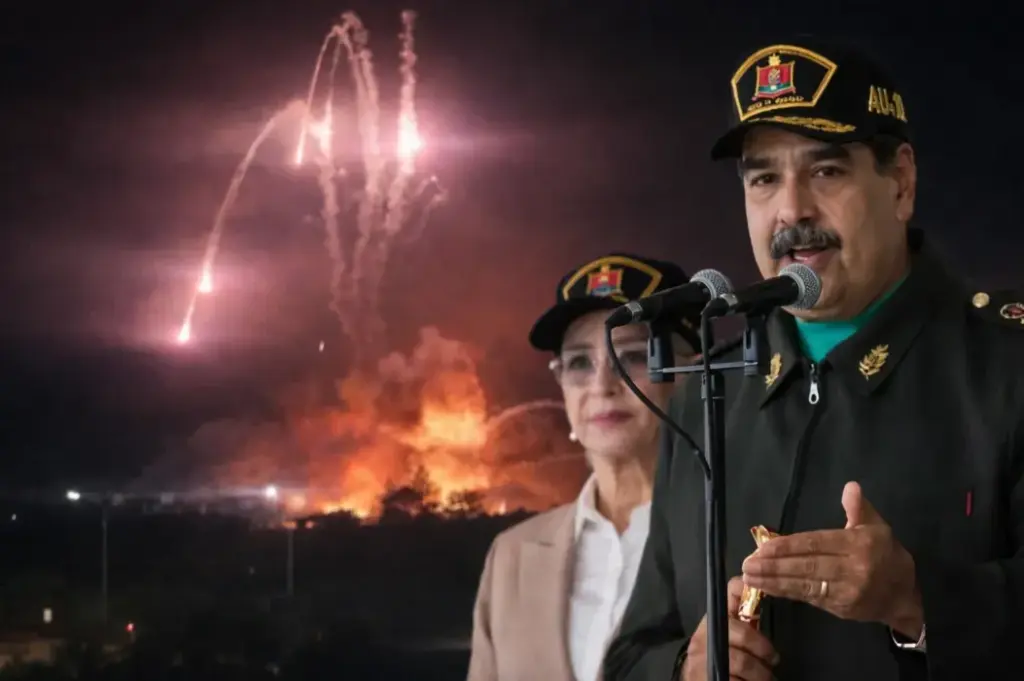
Reports indicate that the operation that led to Maduro’s capture involved precise strikes on key military installations in Caracas. Explosions were heard across the city, raising alarms among the civilian population and prompting a swift government response, including a declaration of national emergency. The chaotic nature of the strikes raises questions about the coordination between U.S. forces and local informants, as well as the tactical strategies employed by the military units involved. Major military sites like Fuerte Tiuna were affected, highlighting the scale and seriousness of the assault.
The aftermath sees Venezuela’s government firmly denying any legitimacy in the operation, with Vice-President Delcy Rodríguez demanding proof of life for Maduro and his wife. This sequence of events has ignited fierce rhetoric from the Venezuelan government, accusing the U.S. of aggressive overreach and declaring intentions to protect the nation’s sovereignty. As the dust settles, the focus shifts to the broader implications for regional security and the geopolitical landscape of Latin America.
Maduro’s Drug Charges and International Implications
Central to the U.S. motivations for Maduro’s capture are the serious drug charges against him and his wife. The U.S. Attorney General has articulated the gravity of the accusations, including conspiracy to commit narco-terrorism and possession of machine guns. These allegations form the basis of a broader narrative that positions Maduro not just as a political figure, but as a leading actor in the drug trade, which has plagued the region and contributed to the humanitarian crisis in Venezuela.
The international community is now faced with the question of how to deal with the legal and diplomatic fallout from the charges against Maduro. Countries that have historically supported Maduro might find it difficult to maintain that stance amidst mounting evidence of drug trafficking activities directly associated with his regime. This presents a critical juncture for international relations, as nations must navigate the complex interplay between diplomacy, drug enforcement, and respect for sovereignty.
Donald Trump’s Role in Maduro’s Capture
President Trump has been at the center of the operation that led to Maduro’s capture, using his platform to reinforce the U.S. stance against drug trafficking emanating from Venezuela. His robust statements, including descriptions of the military operation as a ‘brilliant’ strategy, reflect a broader U.S. policy designed to restore order in a region perceived to be under threat from narco-terrorism. Trump’s administration has positioned itself as a champion of democracy and stability in Latin America, framing Maduro’s capture as a necessary step toward achieving these goals.
However, critics argue that Trump’s approach could lead to increased tension not only with Venezuela but also with international allies who might view such actions as unilateral military aggression. The long-term effects of Trump’s decisions on U.S.-Venezuela relations remain uncertain, as the global community watches closely to see how events unfold following Maduro’s capture.
Venezuela’s Government Reaction to the U.S. Strikes
Following the U.S. military strikes and Maduro’s capture, the Venezuelan government expressed outrage and concern over the violation of its sovereignty. Officials condemned the actions as a direct assault on their nation, invoking strong rhetoric that highlights the polarizing nature of U.S. interventionism. Venezuela’s leadership has called for unity among its allies, seeking to galvanize support against what they describe as unwarranted foreign aggression in their internal affairs.
The Venezuelan response also includes mobilizing its armed forces and a declaration of national emergency, indicating how seriously they regard the threat posed by U.S. military operations. This reactionnot only serves to bolster their internal political narrative but also signals to the international community their determination to resist foreign intervention at all costs. The situation could potentially escalate into a broader conflict if diplomatic channels are not effectively pursued.
International Responses to Maduro’s Capture
Maduro’s capture and the subsequent U.S. military strikes have sparked varied reactions from across the globe, reflecting the complex web of international alliances. Countries like Russia and Iran have harshly criticized the U.S. operation, framing it as an egregious violation of sovereignty. These responses indicate a potential for increased tensions between the U.S. and these nations, which may rally around Maduro in an attempt to counteract what they perceive as American imperialism.
Conversely, there is a faction of nations that may view the U.S. actions favorably, particularly those who have long opposed Maduro’s regime due to concerning human rights records and allegations of widespread corruption. As global leaders reassess their positions, the broader implications of Maduro’s capture could redefine diplomatic relations in the region and beyond. The call for a peaceful transition in Venezuela may gain momentum, but the path forward remains fraught with geopolitical challenges.
The Historical Context of Maduro’s Regime
Understanding the historical backdrop against which Maduro’s capture occurs enriches the narrative of current events. Maduro’s governance has been characterized by allegations of authoritarianism, economic mismanagement, and rising corruption rates, setting the stage for a prolonged power struggle. His ascent to power followed the legacy of Hugo Chávez, who left behind a deeply polarized nation facing severe economic collapse and humanitarian crises fueled by years of misgovernance.
This historical context not only shapes the perception of Maduro within Venezuela but also influences international viewpoints. As nations weigh their responses, they consider the implications of backing a regime that has been involved in significant political strife and has contributed to a mass exodus of migrants fleeing the country. The urgency for democratic reform in Venezuela brings international humanitarian assistance and intervention back into focus.
What Lies Ahead for Venezuela Post-Maduro
With Maduro’s capture, the future of Venezuela remains uncertain. The regime’s structure and response to this unprecedented upheaval will play a critical role in determining whether a peaceful transition or prolonged conflict ensues. Analysts suggest that the power vacuum created by Maduro’s absence could lead to intensified infighting among various factions vying for control, complicating efforts to stabilize the nation and restore basic services to its beleaguered citizens.
Furthermore, the role of external players will be pivotal in shaping the next chapter for Venezuela. As international pressures mount, the potential for sanctions or further military intervention looms large. The global community will be closely monitoring the developments, with actors such as the U.S., Russia, and China positioning themselves within the evolving political landscape. Ultimately, the quest for democracy and recovery in Venezuela may hinge on these international dynamics.
Venezuela’s Drug Trafficking Crisis and Its Global Impact
The drug trafficking crisis in Venezuela is not merely a national issue; it has far-reaching implications for global security, particularly for the United States. Maduro’s administration has been accused of colluding with drug cartels, exacerbating the flow of narcotics entering the U.S. This toxic relationship between state power and organized crime has emboldened various factions, destabilizing not just Venezuela but entire regions plagued by drug-related violence and corruption.
Understanding the global impact of Venezuela’s drug crisis requires acknowledgment of the complex interactions between local governance, international drug trade networks, and U.S. foreign policy. Efforts to combat drug trafficking necessitate collaborative international strategies, focusing on harming the financial networks that sustain these criminal enterprises. The capture of Maduro may serve as a catalyst for heightened global cooperation in tackling the challenges posed by narcotics trafficking fueled by state-sponsored activities.
Frequently Asked Questions
What are the latest updates on Maduro’s capture in Venezuela?
U.S. President Donald Trump announced that Nicolas Maduro and his wife were captured in a U.S. military operation. The details are still emerging, but it involved strikes in Caracas, targeting various military installations.
What charges has Nicolas Maduro faced following his capture?
Following his capture, Nicolas Maduro has been indicted for drug trafficking-related charges, including conspiracy to commit narco-terrorism and possession of firearms, according to U.S. Attorney General Pam Bondi.
What was the nature of the U.S. military operation that led to Maduro’s capture?
The operation involved U.S. military forces, specifically the Delta Force, and included significant airstrikes on key locations in Caracas. The operation aimed to arrest Maduro and prevent further drug trafficking from Venezuela.
How did the Venezuelan government react to Maduro’s capture?
The Venezuelan government has demanded proof of life for Maduro and condemned the U.S. actions as military aggression. They have also declared a national emergency and mobilized military forces.
What has President Trump said about Maduro’s capture?
Trump described the operation as a ‘brilliant’ success and mentioned that more details would be provided in a scheduled press conference. He asserted that Maduro’s arrest is a part of the U.S.’s efforts to combat drug trafficking.
Why is Maduro considered a target for U.S. military operations?
Maduro has been labeled an ‘illegitimate’ leader and is accused of being directly involved in drug smuggling, causing the U.S. to target him for arrest and prosecution.
What were the major sites targeted in the operation that led to Maduro’s capture?
Key locations involved in the operation included Fuerte Tiuna military base, La Carlota Air Base, and Port La Guaira, all of which were struck during the military action.
What implications does Maduro’s capture have for Venezuela and the U.S.?
Maduro’s capture is likely to escalate tensions between Venezuela and the U.S., impacting U.S. foreign policy and the dynamics of power within Venezuela, as well as affecting the ongoing international drug trafficking issues.
How have international reactions shaped the narrative around Maduro’s capture?
Countries like Russia and Iran have condemned the U.S. actions as violations of sovereignty, while the EU continues to call for a peaceful transition of power in Venezuela, showcasing global divisions on this issue.
What background information is needed to understand the context of Maduro’s capture?
Nicolas Maduro has been in power since 2013, succeeding Hugo Chávez. He has been accused of electoral fraud, leading a corrupt regime, and engaging in drug trafficking, resulting in significant U.S. sanctions against his government.
| Key Point | Details |
|---|---|
| Capture of Maduro | Nicolas Maduro and his wife were captured during a US military operation, as confirmed by President Donald Trump. |
| Operation Details | Carried out by US army’s Delta Force, further details expected from a news conference. |
| Reasons for Strike | The US accused Maduro of drug smuggling and legitimate authority, prompting military action. |
| Explosions and Strikes | Explosions occurred in military bases around Caracas during the capture operation. |
| Venezuelan Government’s Response | Demands proof of Maduro’s life, claims the operation targeted civilian areas. |
| International Reactions | Countries like Russia and Iran condemned the US action as an aggression against Venezuela. |
| Charges against Maduro | Indicted on charges related to drug trafficking and possession of weapons. |
Summary
Maduro’s capture marks a significant turning point in US-Venezuela relations, highlighting the ongoing conflicts surrounding drug trafficking and territorial sovereignty. With the US firmly enforcing its stance against Maduro’s regime, the repercussions of his capture are likely to unfold in both domestic and international arenas.