
Listen to this article
What has taken place in recent days in Rojava and Kurdish neighbourhoods of northern Syria is not merely another episode of violence in a long conflict; it is a profound moral rupture that demands the world’s attention. Verified footage and reporting show acts that strip away any remaining illusions about restraint or humanity: a young Kurdish female fighter killed and then publicly desecrated, her body thrown from a building, filmed, mocked, and circulated as a symbol of domination. This was not an act committed in the chaos of battle, nor was it hidden in shame. It was performed deliberately, visibly, as a message meant to humiliate a people and to declare that Kurdish women, Kurdish lives, and even Kurdish dead bodies are unworthy of dignity. Alongside this, deeply disturbing material has circulated portraying Kurdish girls as objects “for sale,” accompanied by language and imagery that weaponise sexual violence and misogyny as tools of terror. Graves have been violated, the dead insulted, and families forced to witness the erasure of respect for their loved ones. These are not isolated crimes or random excesses; they form a pattern of systematic dehumanisation, where cruelty is staged, recorded, and shared to break the spirit of a community and to normalise the unthinkable.
What makes these atrocities even more devastating is the response they have received from the wider world. The evidence is public. The videos are real. The identities of the victims are known. And yet the international reaction has largely been confined to muted concern and cautious statements, unaccompanied by decisive accountability. In this context, silence is not neutrality—it is complicity. Every hour that passes without meaningful action sends a message that such crimes can occur in plain sight without consequence. The Kurdish people of Rojava have already carried an enormous burden, standing at the front lines against extremism and attempting to build lives defined by coexistence and self-determination under relentless pressure. To see their women murdered, their bodies desecrated, and their suffering minimised or ignored is a betrayal of the very principles the international community claims to defend. This page exists because forgetting is easy and silence is comfortable—but both are dangerous. These were not anonymous figures in a video; they were human beings with names, families, dreams, and futures that were violently stolen. History judges not only those who commit such acts, but those who witness them and choose to look away. To document, to speak plainly, and to refuse silence is not provocation—it is the minimum moral responsibility owed to victims whose dignity has been denied in life and in death.
Explainer: What We Know, What Has Been Verified, and Why It Matters
Evidence of Atrocities Against Kurdish Fighters and Civilians in Rojava
This explainer is intended to provide readers with a clear, evidence-based understanding of the events that have circulated widely in recent days concerning Kurdish fighters and civilians in Rojava and Kurdish neighbourhoods of northern Syria. Given the scale of public attention, the availability of video material, and the seriousness of the allegations, it is essential to distinguish between verified facts, documented evidence, and claims that remain under investigation.
1. What the Videos Show
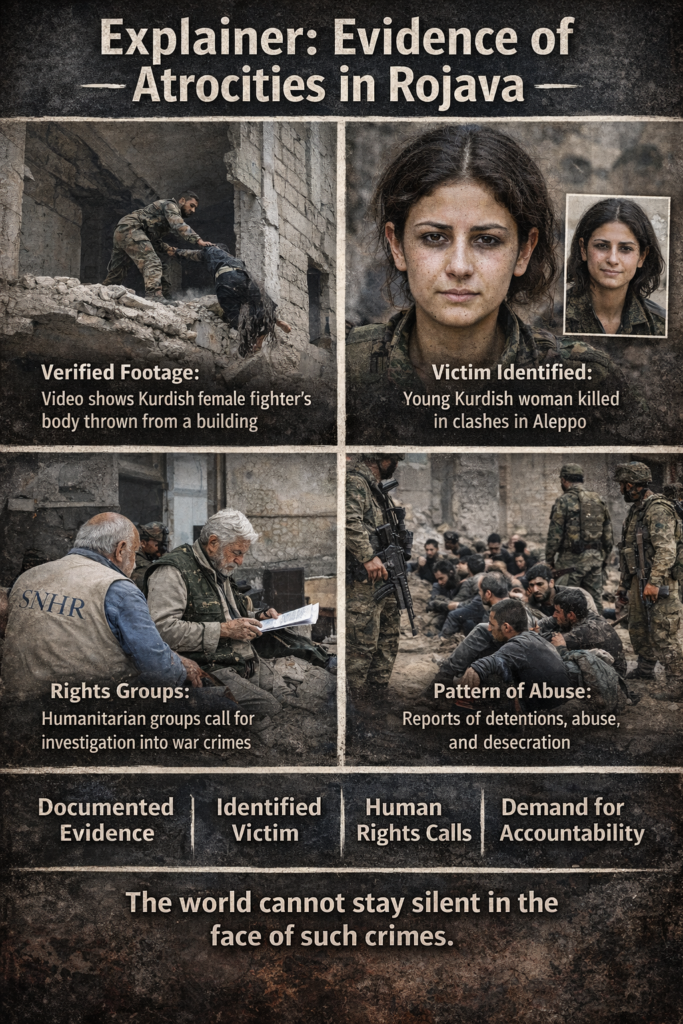
Multiple videos circulated across social media platforms in early January show armed men in military clothing handling the body of a deceased Kurdish female fighter in a degrading manner. In the most widely documented clip, a man is seen lifting and throwing her body from an elevated floor of a damaged building. The act is accompanied by shouting and celebratory behaviour from those present. Independent analysts and human rights observers have confirmed that the footage depicts degrading treatment of a corpse, which is prohibited under international humanitarian law regardless of the victim’s role in the conflict.
Importantly, the footage does not appear to be edited to conceal context, nor does it show signs of manipulation that would suggest fabrication. The act itself is visible and unambiguous.
2. Identification of the Victim
Kurdish security and defence forces publicly confirmed the identity of the deceased woman shown in the footage. She was described as a young female fighter who had been killed during clashes in Kurdish districts of Aleppo before her body was desecrated. This confirmation is significant because it removes ambiguity about whether the footage depicts a real incident involving a real individual, rather than an anonymous or staged scene.
3. Corroboration by Media and Rights Organisations
The incident has been reported by multiple international and regional news outlets and addressed by established human rights organisations. These bodies have independently reviewed the footage and issued statements condemning the act as a violation of the laws of war, specifically the obligation to respect the dead and prohibit mutilation or humiliating treatment. Calls have been made for investigations and accountability, reinforcing that the incident is not considered propaganda or unverified rumor by credible observers.
4. Pattern, Not an Isolated Case
The significance of this incident lies not only in its brutality, but in its context. Reports from the same period describe mass arrests in Kurdish neighbourhoods, intimidation of civilians, and the circulation of additional material that humiliates Kurdish victims, including language that degrades women and mocks the dead. While not every circulating clip can be independently verified, the consistency of themes across verified footage, eyewitness accounts, and reporting suggests a broader pattern of abuse rather than a single, spontaneous act.
5. Legal and Ethical Implications
Under international humanitarian law, all parties to a conflict are bound by clear rules: civilians must be protected, detainees must not be abused, and the dead must be treated with dignity. The public desecration of a body, especially when filmed and shared, constitutes a serious breach of these norms. Human rights organisations have emphasised that such acts may amount to war crimes if confirmed through formal investigation.
6. Why Documentation Matters
The availability of video evidence has played a crucial role in bringing this incident to global attention. However, visibility alone does not guarantee accountability. Documentation, source verification, and responsible reporting are essential to ensure that evidence is preserved, victims are respected, and crimes are not dismissed or forgotten as the news cycle moves on. This explainer exists to ensure that readers understand the factual basis of what has been reported and why these events cannot be reduced to “claims” without substance.
7. The Silence That Follows
Despite the clarity of the evidence and the seriousness of the violations, international response has so far been limited. Statements of concern have not yet translated into concrete action or accountability mechanisms. For many observers, this gap between evidence and response is as troubling as the original act itself, reinforcing fears that crimes against marginalised populations can occur in plain sight without consequence.
Conclusion
The killing and desecration of a Kurdish female fighter is not a matter of opinion, speculation, or online outrage alone. It is supported by visual evidence, confirmed identification, and acknowledgment by reputable media and human rights organisations. The responsibility now lies with international institutions, governments, and the global public to ensure that such acts are investigated seriously and that victims are not erased by silence. Understanding the evidence is the first step toward preventing repetition—and toward honouring those whose dignity was denied even after death.

